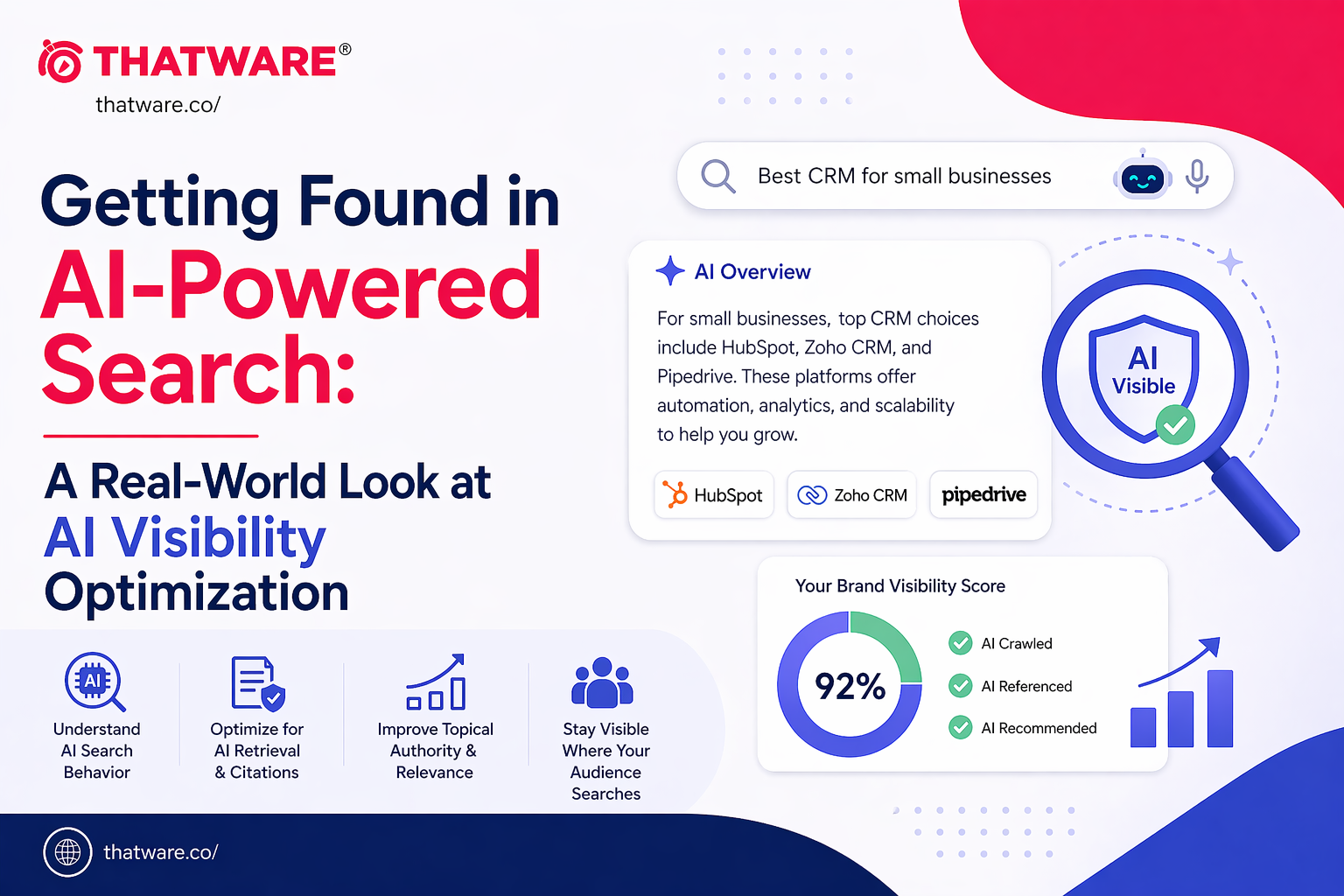
Something interesting happened in 2024 and into 2025 that a lot of brands are still processing: search stopped being purely about web pages. It started being about answers. And that’s a deceptively large change in what it actually means to be “visible” online.
When someone uses ChatGPT, Perplexity, Google’s AI Overviews, or any number of AI-assisted search tools, they’re not necessarily seeing a list of links to choose from. They’re getting a synthesized answer – one that may or may not mention your brand, your content, or your expertise. Whether you show up in that answer has nothing to do with whether you rank on page one. It has to do with a completely different set of factors, most of which the traditional SEO industry is only beginning to understand.
This is the world that AI visibility optimization was built for.
The Gap Between Rankings and Visibility
For a long time, “search visibility” meant rankings. Higher position, more clicks, better visibility. It was clean, measurable, and reasonably predictable if you knew what you were doing.
Related storyThe Quiet Shift Toward Personal AI: Why Your Next Assistant Might Live Inside Your Device
That model hasn’t disappeared – traditional organic search still drives meaningful traffic, and rankings still matter. But a growing share of search journeys are now mediated by AI. Someone asks a question, an AI system answers it, and the original sources either get credited or they don’t. Either way, the user often gets their answer without clicking through anywhere at all.
For brands, this creates a visibility gap. You can rank #1 for a keyword and still not appear in the AI-generated answers that a significant portion of your audience is receiving. And you can theoretically be cited in AI answers without ranking particularly well in traditional search.
These are different systems with different optimization requirements – and treating them as the same thing is a mistake that’s becoming increasingly costly.
Related storyA Mirror in the Machine: How Digital Twins Are Quietly Changing Real-World Work
What AI Systems Are Actually Looking At
Understanding AI visibility starts with understanding how these systems evaluate content. Large language models and AI search tools aren’t scanning for keywords. They’re evaluating credibility, comprehensiveness, and clarity – essentially asking: is this source genuinely authoritative on this topic, and does its content fully and accurately address the question being asked?
A few things matter a lot in this context. Factual accuracy and internal consistency – AI systems are trained to recognize content that contradicts itself or makes claims that don’t hold up. Breadth and depth of topic coverage – a brand that has published a dozen well-structured pieces covering all angles of a topic is more likely to be recognized as an authority than one with a single piece optimized for a keyword. Named entities and clear attribution – content that clearly establishes who is behind it, what credentials or experience backs it, and how it relates to a larger body of work is easier for AI systems to evaluate positively.
Ai visibility optimization services address all of these dimensions. It’s not about gaming AI systems – it’s about genuinely building the kind of content presence and brand authority that these systems are designed to recognize and surface.
The Entity Layer
If there’s one concept that bridges traditional SEO and AI visibility, it’s entity optimization. Search systems – both traditional and AI-powered – think in terms of entities: distinct, recognizable things (brands, people, places, concepts) with defined relationships to other entities.
Related storyWhen “Free” Doesn’t Feel Free Anymore: Why Privacy-First Apps Are Getting Attention
For AI visibility specifically, entity clarity is critical. AI systems need to be able to recognize your brand clearly – to have a coherent “understanding” of what you do, who you serve, and what you know. That coherence comes from consistent, clear signals across many sources: your website, third-party publications, directories, social profiles, Wikipedia if relevant, review platforms, and more.
If the picture AI systems can assemble of your brand is thin, inconsistent, or unclear – if there are conflicting descriptions, sparse third-party mentions, or no obvious topical focus – you’re much less likely to be surfaced in AI answers, even if your content is good.
This is one of the most actionable things brands can work on right now, and most are completely ignoring it.
AIEO: The Discipline Emerging From This Shift
There’s a growing body of practice sometimes called AIEO – Artificial Intelligence Experience Optimization – that addresses AI visibility as its own discipline rather than a subset of traditional SEO. It’s still evolving, but its contours are becoming clearer.
Aieo services typically involve auditing how AI systems currently perceive and represent your brand, identifying gaps in content coverage that prevent your brand from being a complete authoritative source in your domain, improving entity clarity across the web, and optimizing content structure and schema markup to help AI systems parse your content accurately.
Measuring success in AIEO is different from traditional SEO measurement. You’re not just tracking keyword rankings – you’re tracking things like whether your brand appears in AI-generated answers for relevant queries, how accurately those answers represent your brand, and whether AI systems are drawing from your content when synthesizing responses.
It’s a newer measurement framework and the tools are still catching up, but the underlying principle is clear: if AI-mediated search is where a growing share of your audience is getting their answers, your brand needs to be optimized for that context, not just for the ten blue links.
Practical Starting Points
If you’re trying to figure out where to begin with AI visibility, a few concrete first steps are worth taking.
Start by testing how AI systems currently describe your brand. Ask ChatGPT, Perplexity, and Google’s AI Overviews questions that your target customers might ask. Does your brand appear? Is the information accurate and complete? That gap analysis will tell you a lot about where your entity presence needs work.
Then look at your content from the perspective of comprehensiveness. For the topics most central to your business, does your content fully cover the subject – including nuances, edge cases, and follow-up questions – or does it cover only the high-traffic keyword variations? Comprehensiveness is one of the strongest signals of authority in AI systems.
Finally, look at your off-site presence. Are there credible, third-party mentions of your brand that AI systems could draw on to verify your authority? Industry publications, relevant directories, expert profiles, community contributions – these all feed into the picture AI systems form of your brand.
None of this is fast work. But it’s increasingly foundational work – the kind that determines whether your brand remains visible in the search landscape that’s actually emerging, rather than the one that existed a few years ago.