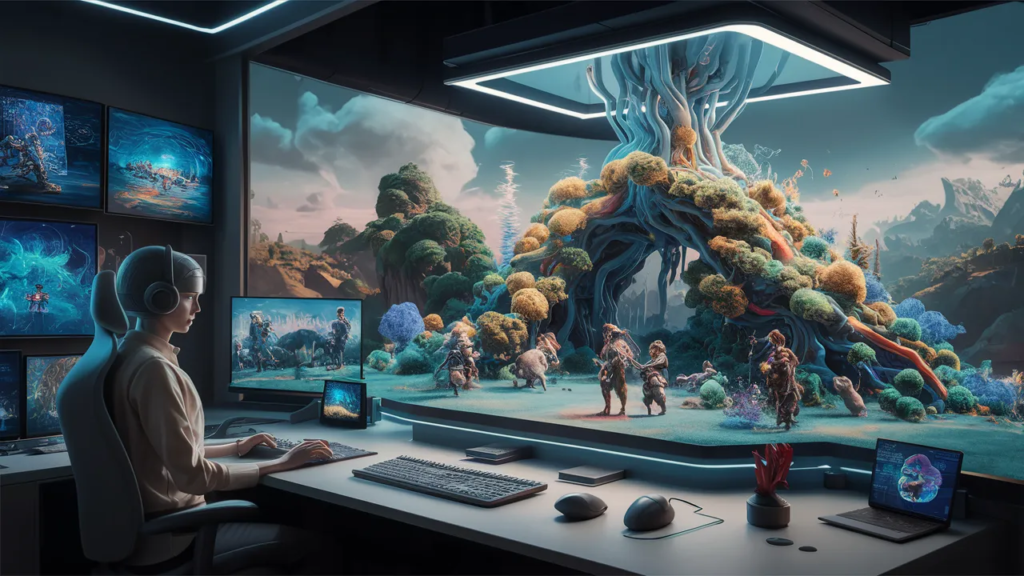
There was a time when every inch of a video game world had to be handcrafted. Artists painted textures, designers placed every tree, every rock, every shadow. It was meticulous work—beautiful, but slow. And honestly, a little limiting.
Now, something is changing. Game worlds are starting to feel… alive in a different way. Not just because of better graphics or bigger maps, but because of how they’re being created. AI is stepping in—not to replace creativity, but to stretch it.
From Designed Worlds to Generated Worlds
Traditionally, building a game environment meant planning everything in advance. You had a map, a layout, a vision. It worked well, but it also meant repetition. Once players explored everything, the sense of discovery faded.
Related storyWhy Game Subscription Services Haven’t Quite Taken Off in India—At Least Not Yet
AI-generated environments flip that idea. Instead of fixed worlds, you get dynamic ones—maps that can change, landscapes that evolve, details that feel less predictable. It’s not just about size anymore; it’s about variation.
And that variation matters. Players notice when things feel fresh, even if they can’t quite explain why.
The Appeal of Endless Possibility
One of the biggest advantages of AI in game design is scale. Developers can create massive worlds without manually building every element. Procedural generation isn’t new, of course—games like Minecraft have been doing it for years—but AI takes it a step further.
Related storyThumbs vs Keyboards: Where India’s Esports Growth Story Really Lies
It adds nuance. Patterns become less obvious. Environments feel more organic, less “generated.”
For players, this translates into longer engagement. There’s always something new to explore, even in familiar settings. That unpredictability keeps curiosity alive.
Creativity Isn’t Going Anywhere
There’s a common fear that AI will replace artists and designers. But in reality, it’s shifting their role rather than eliminating it.
Related storyHow to Choose a Pool Table That Fits Your Rapid City, South Dakota Home
Instead of building everything from scratch, creators are guiding systems—setting rules, defining styles, shaping outcomes. It becomes more about direction than execution.
Think of it like a filmmaker working with advanced tools. The vision still comes from a human mind; AI just helps bring it to life more efficiently.
The Question Everyone’s Asking
At some point, the conversation naturally turns into a bigger question: AI-generated game environments ka future gaming industry ko kaise impact karega?
It’s not just about better graphics or faster development. It’s about redefining how games are experienced.
Imagine worlds that adapt to your playstyle. Environments that change based on your decisions, not just scripted events. Games that feel less like products and more like living systems.
That’s where things start to get really interesting.
Challenges Behind the Scenes
Of course, it’s not all smooth sailing.
AI-generated environments can sometimes lack coherence. Without careful guidance, worlds might feel random rather than meaningful. There’s a fine line between variety and chaos.
There’s also the issue of control. Developers need to ensure that generated content aligns with the game’s narrative and design goals. Too much randomness can break immersion.
And then there’s the technical side—processing power, optimization, integration. These aren’t small hurdles.
A New Kind of Player Experience
What excites me most isn’t just the technology—it’s how it changes the player’s relationship with the game.
When environments aren’t fixed, exploration feels different. You’re not just uncovering what the developers placed there; you’re interacting with a system that responds and evolves.
It adds a layer of unpredictability that traditional design can’t fully replicate.
And for genres like open-world games, survival titles, or even RPGs, that unpredictability can be a game-changer—literally.
Indie Developers Stand to Gain
Interestingly, smaller studios might benefit the most from this shift.
Creating large, detailed worlds has always been resource-intensive. AI tools can level the playing field, allowing indie developers to build experiences that previously required massive teams.
This could lead to more experimentation, more unique ideas, more diversity in the kinds of games we see.
And honestly, that’s something the industry could always use more of.
Not a Replacement, But an Evolution
It’s tempting to frame AI as a disruption, something that overturns everything that came before. But in many ways, it feels more like an evolution.
Game design has always embraced new tools—from 2D to 3D, from static maps to open worlds. AI is just the next step in that progression.
It doesn’t erase the past. It builds on it.
A Final Thought
There’s something quietly fascinating about worlds that can grow, shift, and surprise us—even after we think we’ve seen it all.
AI-generated environments aren’t just about efficiency or scale. They’re about possibility. About giving both developers and players a little more room to explore, to experiment, to imagine.
And maybe that’s the real impact. Not just bigger games, but more dynamic ones.
Games that don’t just tell stories—but keep creating them, long after the first playthrough ends.