Water is often treated as a basic utility in industrial facilities, something that simply arrives through a pipe and leaves through another. But in many industries, water is part of the process itself. It may be used for cleaning, cooling, heating, processing, rinsing, manufacturing, or transporting materials. When that water contains unwanted minerals, sediment, chemicals, or other impurities, the consequences can reach far beyond the tap.
For manufacturers, food processors, warehouses, laboratories, and other facilities, water quality can influence equipment reliability, operating costs, maintenance schedules, and the consistency of finished products. That’s why filtration deserves more attention than it sometimes gets.
Why Industrial Water Filtration Is Different
A typical household filtration system has a relatively simple job. Industrial facilities are another story.
Related storyWhy Water Purity Matters More in Commercial and Specialized Applications
Water demand can be enormous, and the required flow rate may change throughout the day. Some processes require highly filtered water, while others only need sediment or specific contaminants reduced.
That’s why industrial water filtration systems are usually designed around the facility’s actual requirements rather than using a one-size-fits-all approach.
The water source matters, too. Municipal water, groundwater, surface water, and recycled process water can have very different characteristics. Before choosing equipment, facilities should understand the chemistry and physical properties of the water they’re working with.
Start With Water Testing
It may sound obvious, but water testing is one of the most useful steps in designing an industrial filtration system.
Related storyA Smarter Environmental Choice for Water Treatment Starts With Managing Hard Water
A detailed analysis can provide information about hardness, pH, iron, manganese, chlorine, sediment, dissolved solids, and other characteristics relevant to the process.
Why does that matter? Because different contaminants require different treatment methods.
A sediment filter won’t solve every chemical problem. A carbon filter isn’t designed to remove everything. Reverse osmosis has its own applications and limitations. If you don’t know what’s in the water, selecting treatment equipment becomes a bit of a guessing game.
Testing turns that guesswork into a more informed decision.
How Poor Water Quality Can Affect Equipment
Industrial equipment often represents a substantial investment. Pumps, boilers, heat exchangers, production machinery, cooling systems, and other components can be sensitive to water chemistry.
Hardness minerals, for example, can form scale on heat-transfer surfaces. Sediment can collect in valves and narrow passages. Certain water conditions may encourage corrosion.
Over time, these issues can reduce efficiency or increase maintenance requirements.
This is where equipment protection becomes one of the major reasons businesses invest in water treatment. Filtration isn’t simply about producing cleaner-looking water. It can help reduce exposure to substances that may interfere with the performance or longevity of equipment.
Of course, filtration alone can’t prevent every mechanical failure. Proper equipment design and maintenance remain essential.
Scaling and Mineral Deposits
Hard water is a common concern in industrial environments. Calcium and magnesium can accumulate on surfaces, particularly where water is heated or evaporated.
Related storyChoosing the Right Water Treatment Installation Approach for Cleaner, Healthier Water at Home
A layer of scale may not look particularly impressive, but even a relatively thin deposit can affect heat transfer. When equipment has to work harder to achieve the same result, efficiency can suffer.
Depending on the facility, treatment may include water softening, specialized filtration, reverse osmosis, or other processes designed for the specific water chemistry.
The right choice depends on the application. That’s why simply purchasing a “high-capacity” filter isn’t enough.
Related storyWhy Reliable Water Systems Are Becoming a Smart Investment for Modern Businesses
Protecting Manufacturing Processes
Water quality can matter just as much to the process as it does to the machinery.
In food and beverage production, water may become part of the product itself. In pharmaceutical or laboratory applications, water purity can be critical. In manufacturing, water may be used for rinsing, cooling, coating, or cleaning.
If the water changes unexpectedly, the production process may change with it.
This is one reason consistent filtration and monitoring can be valuable. A stable water supply helps businesses maintain predictable operating conditions rather than constantly adjusting to changing water characteristics.
Better Water Can Support Product Consistency
For manufacturers, consistency is everything. Customers expect the same product today that they received last month.
Depending on the industry, untreated or inconsistently treated water can influence cleaning results, processing conditions, surface appearance, or other production factors.
That makes enhanced product quality a potential benefit of effective water treatment. The exact impact will vary by industry and process, but consistent water quality can remove one source of unwanted variability.
It’s not a magic shortcut to better products. Good filtration has to work alongside proper production controls, sanitation, maintenance, and quality assurance.
Still, controlling the water supply is one piece of the larger puzzle.
Choosing the Right Filtration Technology
Industrial filtration can involve several technologies, sometimes used together.
Common approaches include:
- Sediment filtration for suspended particles
- Activated carbon for certain taste, odor, and chemical concerns
- Water softening for hardness minerals
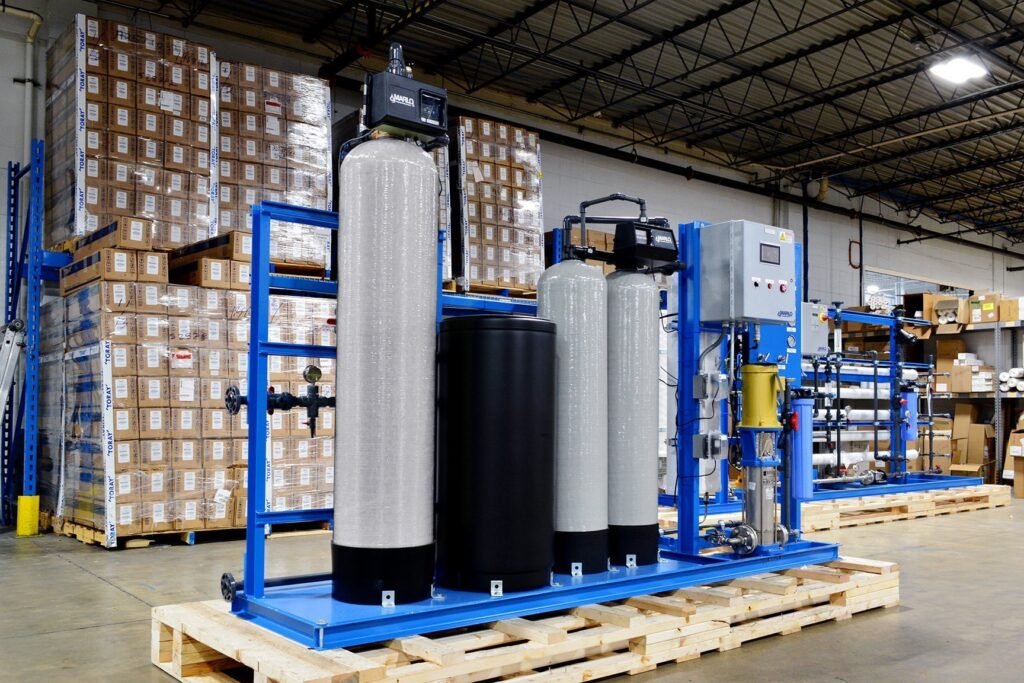
- Reverse osmosis for reducing many dissolved substances
- Specialized media for iron, manganese, or other specific conditions
- UV treatment for certain microbiological applications
The appropriate combination depends on the water analysis and process requirements.
Facilities should also consider flow rate, pressure, operating temperature, space, maintenance access, and future capacity. A system that works beautifully at today’s production level may struggle if the facility expands.
Don’t Overlook Maintenance
Filtration equipment needs maintenance just like every other industrial system.
Filters become loaded with contaminants. Membranes require cleaning or replacement. Pumps, valves, and controls need inspection. Treatment media may eventually need replacement or regeneration.
A maintenance schedule should be part of the original system design, not something added after a problem occurs.
Operators should also monitor pressure differences across filters and watch for changes in water quality. A sudden increase in pressure drop, for example, can indicate that a filter is becoming loaded.
Early detection is usually easier—and cheaper—than emergency repair.
Think About Total Operating Costs
The purchase price of filtration equipment is only one part of the financial picture.
Businesses should consider energy consumption, replacement filters, water usage, wastewater disposal, chemicals, labor, maintenance, and downtime.
A system with a slightly higher initial cost might be more economical if it operates efficiently and requires less frequent servicing. On the other hand, unnecessary treatment stages can increase costs without adding meaningful value.
The goal is balance.
A Smarter Approach to Industrial Water
Industrial water filtration isn’t about chasing perfectly pure water for every application. It’s about delivering water that is appropriate for the job.
Start with testing. Understand the process. Identify the contaminants that matter. Choose technology around those requirements, and build maintenance into the plan from day one.
When water quality is controlled properly, the benefits can extend across the facility—from equipment reliability to production consistency and operating efficiency.
The best filtration system is the one that quietly supports the work happening around it. You may not notice it every day, and that’s actually a good thing. It means the water is doing its job, the equipment is doing its job, and the business can keep moving forward.